If you’ve just begun the process of exploring all the different varieties of beef jerky, you’re in luck – you have countless options. It isn’t just a matter of finding a brand with the most flavors; jerky can also be differentiated by the type of meat that’s used, nutritional type, texture, and far more. When embarking on your jerky-sampling journey, don’t just try out every flavor you can find at the local supermarket. There are all kinds of wonderful flavors and textures to be discovered if you look online, and it’s easy to find some of the best jerky available from companies like JerkyGent. Once you know what the possibilities are, you’ll be able to hone in on your favorite types.
The question is, what are the different types of beef jerky? They can be categorized in a few ways:
- By flavor
- By form
- By nutritional type
- By texture
- By source
Let’s take a closer look at each one.
Flavors of beef jerky
This is probably the category with the most variation, as there are almost infinite beef jerky flavors available. However, they can all be put into one of three categories: mild, sweet, and spicy.
- Mild beef jerky is the quintessential jerky, characterized by salt-and-pepper flavors that most people are already familiar with. There can also be variations on these seasonings, such as sea salt and black pepper, or garlic.
- Sweet beef jerky can be only slightly sweet, or it can practically be candied meat. Sugar is commonly used in sweet varieties not only for the flavor, but also for the texture. This could take the form of honey, corn syrup, brown sugar, or cane sugar. One of the most popular sweet jerky flavors is teriyaki; others include orange honey teriyaki and honey glazed.
- Spicy beef jerky also has a wide range; it could have a slight kick, or it could make your face feel like it’s on fire. In most cases, the heat comes from the use of peppers such as cayenne, jalapeno, habanero, and chipotle. On the hotter end of the spectrum, you can find beef jerky that’s made with the Carolina Reaper or ghost peppers, which are some of the world’s hottest peppers.
Forms of beef jerky
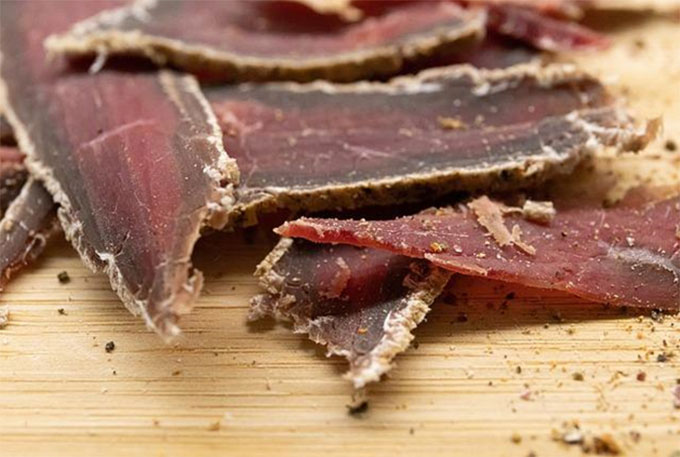
The original form of beef jerky was just pieces of muscle meat cut into strips and dried. This ensured that higher-quality cuts of meat were used, as the jerky had to be relatively free of sinew, fat, or other connective tissue. This is the most common form of beef jerky, especially with higher-quality jerky brands.
The other option is restructured beef jerky, which is made from beef that’s been chopped up and then reformed into the desired shape. This isn’t always an indication that lower-quality cuts of meat were used, but it is a way for manufacturers to use cheaper cuts without anyone being able to tell. If you aren’t sure about the quality of restructured jerky, just look at the ingredients. If it’s relatively free of artificial additives, it’s probably a higher-quality product.
Nutritional types of beef jerky
The beef component of beef jerky may not cause issues, but there are several other ingredients that possibly could. For instance, most beef jerky is fairly high in sodium; if you’re trying to cut down on your salt intake, you could choose low-sodium jerky.
Sugar-free jerky is also available for anyone who’s trying to avoid this ingredient. You could stick with the original salt-and-pepper flavors, or you could try sweet jerky made with alternative sweeteners.
What about gluten-free jerky? This isn’t a marketing gimmick. Some people have to avoid gluten for health reasons, and soy sauce, a common ingredient in jerky, is a source of gluten.
Textures of beef jerky
Second to flavor, this is probably the category of beef jerky with the most variation. Even though the basic form of jerky is just dried meat, the ingredients and drying process can have a big influence on the texture of the final product. Originally, beef jerky was pretty hard and tough – it’s also nicknamed “cowboy jerky”. This is what you get with minimal ingredients, no tenderizing process, and no marination.
Old-fashioned beef jerky takes a bit of work to get through. Eating something that can be described as “dry and tough” may not sound enjoyable, but fans of this type of jerky can’t get enough of it. As you chew the dried meat, it gradually softens and reveals its rich flavor profile. It isn’t just a tasty snack; it’s also an experience that’s worth the effort.
Soft beef jerky, as the name implies, is much softer. If you find a beef jerky with more modern, complex flavors, it’ll probably be this type of jerky. Due to the cooking and drying process, the use of marinades, and the use of tenderizer machines, soft jerky is much easier to bite and chew.
These are the two ends of the texture spectrum, with plenty of varieties in between. Some people are traditionalists, while others enjoy exploring the gourmet flavors of soft jerky. Even though the purists would say otherwise, any texture of jerky is perfectly valid. If you enjoy it, then who’s to say you shouldn’t?
Sources of beef jerky
For some people, the origins of the food they eat is very important. This is why they differentiate between jerky from corn-fed, grass-fed, or grass-finished cows. They might also look for organic, hormone-free, or antibiotic-free beef.
The vast majority of beef jerky comes from corn-fed cows, as these are the most commonly available source of beef. However, it isn’t too hard to find jerky from higher-quality sources. They typically cost a bit more, but that’s a trade-off that many people are willing to make.
The takeaway
Beef jerky started out as a simple way to preserve a perishable product, but it’s evolved into a wonderful array of flavors, textures, and forms. There’s no telling how many varieties of beef jerky are out there, but that’s great news for fans of this snack – they’ll never run out of options!



Leave a Reply